Why Southwest Florida Has Some of the Hardest Water in the Country
Why Southwest Florida Has Some of the Hardest Water in the Country
If you've lived in Southwest Florida for more than a year, you've probably noticed a few things. White rings on your shower doors that come back two days after you scrub them. Spots on every glass that comes out of the dishwasher. Dry skin that no amount of lotion seems to fix. Faucet aerators that clog within a year. A water heater that fails years before the manufacturer's warranty said it would.
None of this is in your head. It isn't your soap. It isn't your appliances. It's the water.
Specifically, it's some of the hardest water in the United States — and it's the direct result of the unique geology underneath your feet.

The Floridan aquifer (and why limestone is the problem)
Most of Southwest Florida — Lee, Collier, Charlotte, and the counties surrounding them — sits directly on top of the Floridan aquifer, one of the largest underground freshwater systems in the world. The Floridan stretches across most of Florida and parts of Georgia, Alabama, and South Carolina, holding billions of gallons of water in a vast network of porous rock.
That rock is limestone.
And limestone is mostly made of calcium carbonate.
When water sits in or moves through limestone for thousands of years — which it has — it slowly dissolves the rock and absorbs the minerals, primarily calcium and magnesium. By the time that water reaches your home's faucet, it's carrying a heavy mineral load picked up from the aquifer it just came from.
Those dissolved minerals are exactly what "water hardness" measures.

What "hard water" actually means
Water hardness is measured in grains per gallon, or GPG. Here's how the U.S. Geological Survey classifies it:
Classification Grains per Gallon Soft 0–1 GPG Slightly hard 1–3.5 GPG Moderately hard 3.5–7 GPG Hard 7–10.5 GPG Very hard 10.5+ GPG
The EPA generally considers water "hard" once it crosses 7 GPG. Anything above 10.5 is officially "very hard."
In Southwest Florida, the average is 12 to 20 grains per gallon, with some inland and well-water areas measuring well above that. Naples and Bonita Springs tend to run on the higher end of that range. Cape Coral well water can test north of 25 GPG depending on the depth and location of the well. Inland zones in Lee and Charlotte counties — places like Lehigh Acres and parts of Punta Gorda — are similar.
For context: the national average is around 7 GPG. New York City water averages 1–2 GPG. Even cities famously known for hard water — Indianapolis, Phoenix, Las Vegas — usually run 12–15 GPG.
In other words: SWFL water isn't just hard. It's hard even by the standards of regions that are already considered hard.

What 15 grains per gallon actually does to your home
Hard water sounds abstract until you see what it does over a decade. Here's the short list of what's silently happening to every Southwest Florida home that doesn't have a softener.
Appliances die younger. Water heaters are the most dramatic case. A water heater designed to last 12–15 years often fails within 5–8 years in SWFL because of scale buildup on the heating element and inside the tank. Dishwashers, washing machines, ice makers, and coffee makers all show similar shortened lifespans. The aggregate cost of replacing these appliances 30–50% earlier than expected, across a decade or two of homeownership, is often measured in five figures.
Soap and detergent stop working. Hard water reacts with soap to form a sticky, insoluble residue — the same "soap scum" you scrub off the shower doors. You need significantly more soap, shampoo, and laundry detergent to achieve the same cleaning effect. Most softener manufacturers cite 50–75% reductions in household detergent use after installation. That's real money over time.
Plumbing scales shut. The white crust you see around faucet aerators and showerheads is calcium scale. It builds up inside your pipes the same way — gradually narrowing them and reducing your home's overall water pressure over years. Older SWFL homes with their original plumbing routinely have visible scale buildup inside the pipe walls.
Glass etches permanently. Hard water spots aren't just deposits sitting on the surface — over time, calcium and magnesium actually etch into glass, creating cloudiness that no amount of cleaning will ever remove. This is why so many older SWFL homes have permanently hazy shower doors that look "dirty" no matter how often they're scrubbed.
Skin and hair pay the price. The same minerals that wreck your dishwasher also leave a film on your skin and hair after every shower. Combined with the soap-scum residue, this is why so many Southwest Florida residents struggle with dry skin, brittle hair, and skin issues that don't quite respond to lotion or shampoo changes — even when they're already using "good" products.
Energy bills climb. A scaled water heater works harder. The Battelle Memorial Institute has published research showing that just a quarter-inch of scale buildup on a water heater element can reduce its efficiency by up to 40%. That's a meaningfully higher electric or gas bill, every month, indefinitely.

"But I'm on city water — isn't that already softened?"
A common misconception in Southwest Florida is that municipal water — Bonita Springs Utilities, Lee County Utilities, City of Naples water, and so on — is automatically soft. It isn't.
Municipal treatment plants are designed to make water safe to drink. They filter out bacteria, add chlorine for disinfection, and balance pH. They don't typically remove hardness. Hardness removal is energy-intensive and most U.S. utilities don't do it at scale. So while your city water is safe to drink, it's still carrying the same calcium and magnesium load from the limestone aquifer it originated in.
If you're on a private well, your hardness is even less filtered — well water comes straight from the aquifer with no municipal treatment at all, and often picks up additional iron, sulfur, and sediment along the way. That's why well-water homes in eastern Lee County, Golden Gate, and Charlotte typically have even more dramatic hard-water symptoms than city-water homes closer to the coast.
What actually fixes it
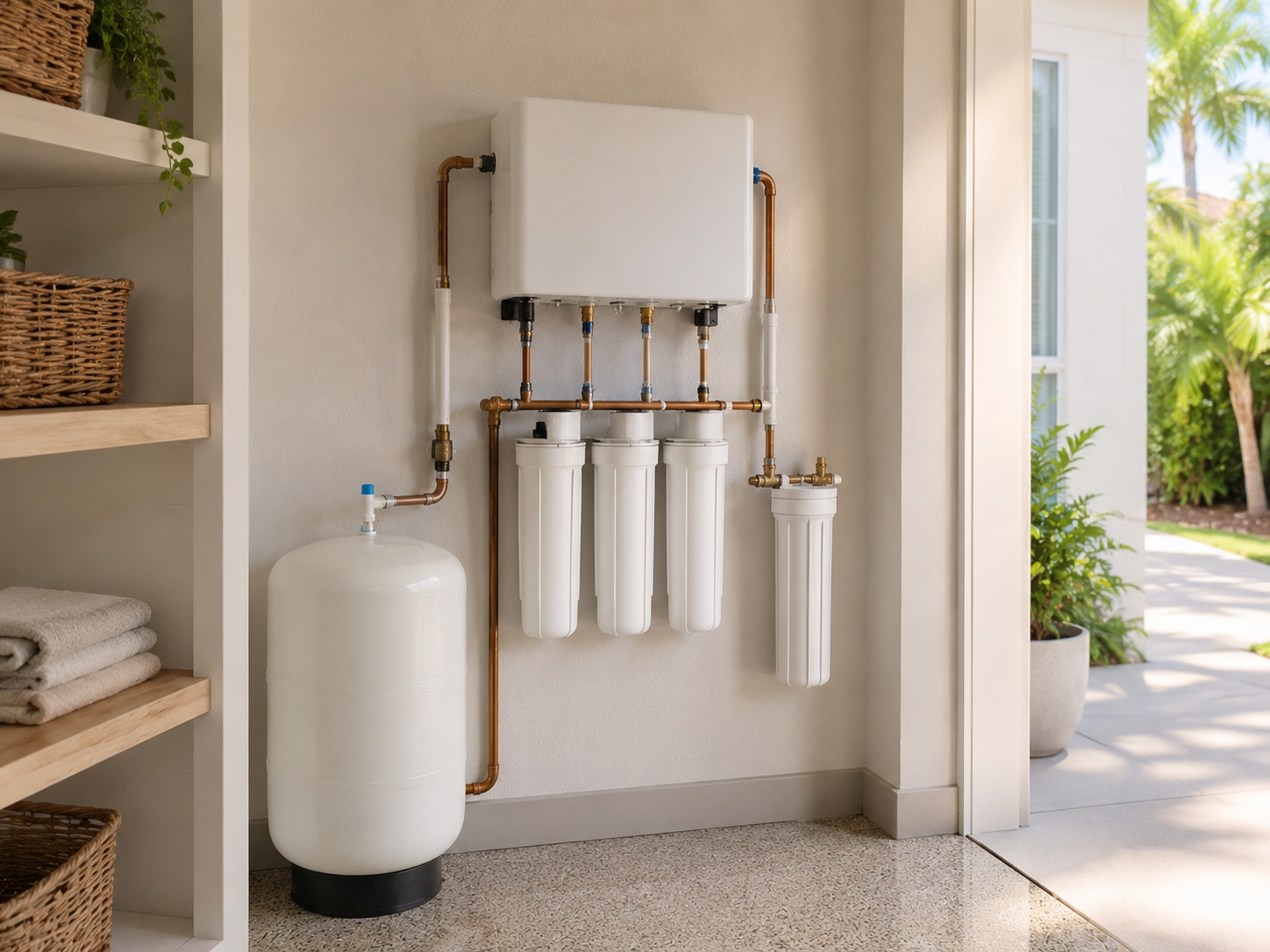
A whole-home water softener.
That's it. There's no plumbing trick, no faucet filter, no "magnetic device that breaks up calcium" (none of those work — and there's good independent research showing they don't). The only proven, long-term fix for hard water at SWFL's hardness levels is an ion-exchange water softener installed at your home's main water line.
A softener works by swapping the calcium and magnesium ions in your water with sodium or potassium ions. The result is water that no longer scales, no longer etches, no longer wrecks your appliances, no longer leaves film on your skin, and no longer makes your soap useless. Once installed, a quality system operates for 10–15+ years with minimal maintenance — just periodic salt refills.
The economics tend to work out favorably even at SWFL's hardness levels. Most homeowners recoup the cost of a softener within 3–7 years through extended appliance lifespan and reduced soap/detergent use alone — before even counting the daily quality-of-life improvements that are honestly the bigger reason most people end up installing one.
A note from our family
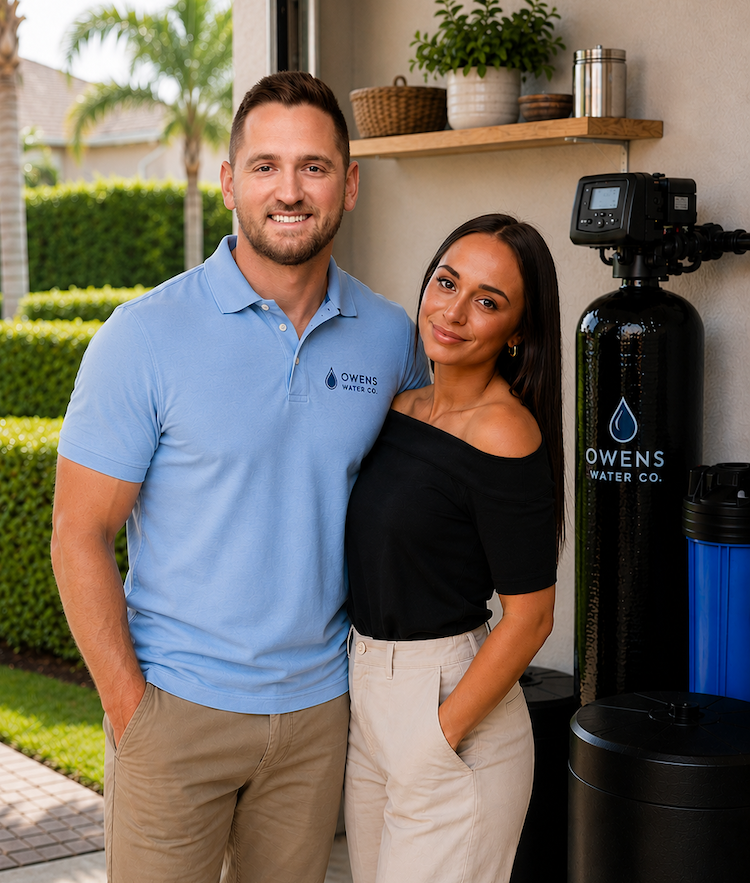
We started Owens Water Co. because we got tired of watching our neighbors here in Southwest Florida pay $10,000 or more for water softener systems that should cost a fraction of that. The equipment is the same equipment our competitors install. The installation is performed by the same licensed and insured plumbing partners. The only thing that changes between us and a high-pressure salesman from a national chain is who pockets the markup.
Honest education comes first. If you read this post, learned something about your water, and decided you don't need a softener — we're glad we could help.
If a softener is right for your home, we'd love to be the family that installs it. Call or text us at (239) 256-4014 and we'll give you a straight answer about your specific situation — whether you're on well water, city water, an older home, or a newer build.
— Alex and Annie, Owens Water Co. Bonita Springs, FL