Reverse Osmosis vs. Whole-Home Filtration
Reverse Osmosis vs. Whole-Home Filtration: Which Do You Need?
This is one of the most common questions we get from Southwest Florida homeowners. They've heard about water softeners. They've heard about whole-home filters. They've heard about reverse osmosis. And they're not sure which one — or which combination — actually fits their home.
The short answer: they do different things, and most homes that take water quality seriously end up with both. But understanding why requires a quick walk through what each system actually does.
Whole-home filtration: water quality at every tap
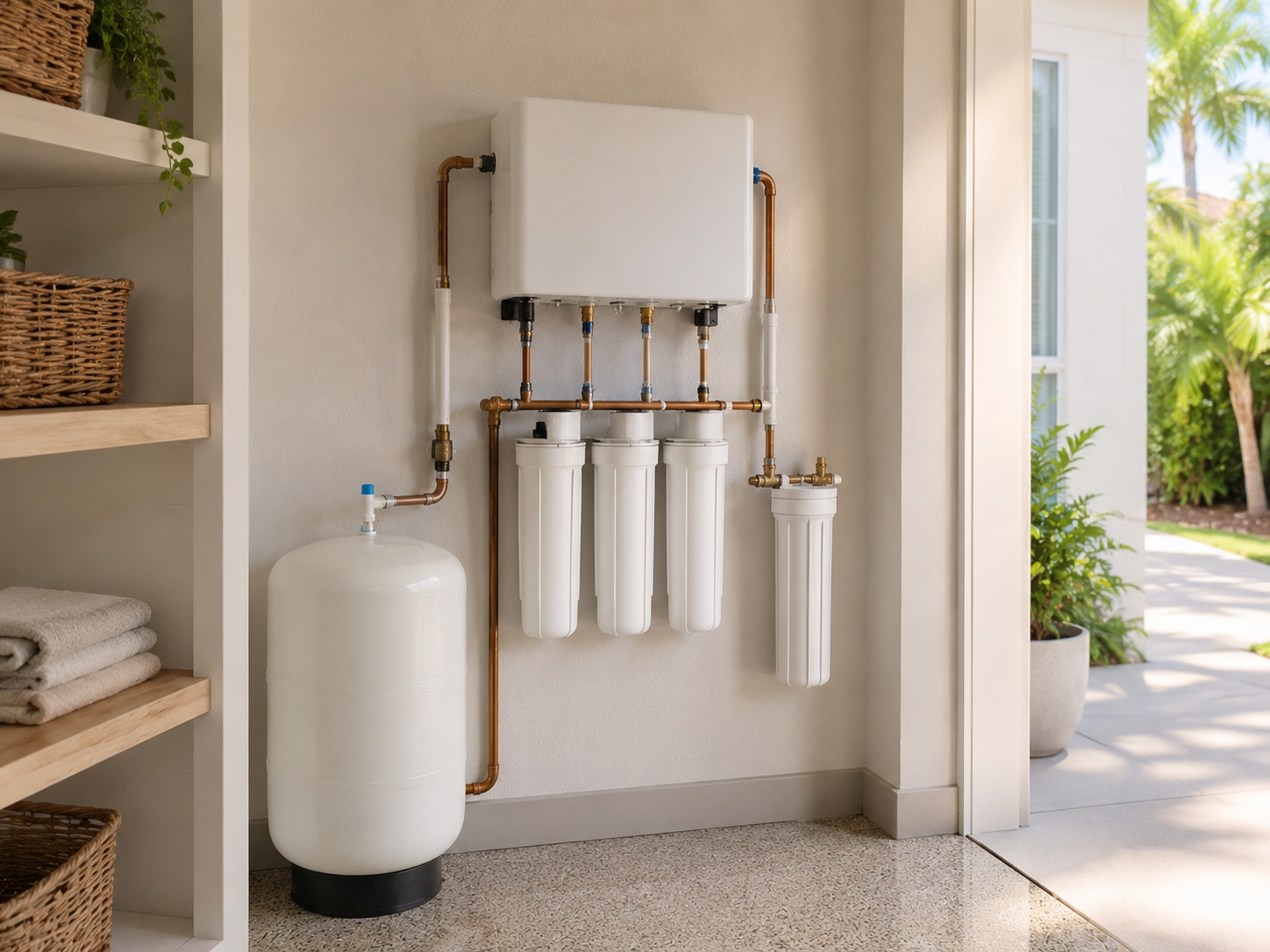
A whole-home water treatment system installs at the point of entry — the main water line where water enters your home from the city or your well. From that single point, it treats every drop of water that flows to every faucet, shower, appliance, and outlet in your house.
The exact configuration varies, but a typical whole-home system in Southwest Florida handles three jobs:
Hardness removal (softening). Through ion exchange, calcium and magnesium ions are swapped out for sodium or potassium ions. This is what fixes the spotty dishes, the dry skin, the etched shower doors, and the appliances that fail too early.
Chlorine and chloramine reduction. Municipal water is chlorinated for safety, but chlorine is harsh on hair, skin, and the rubber gaskets in your appliances. A whole-home carbon filter strips the chlorine before it reaches your taps.
Sediment filtration. Especially relevant in well-water homes — Eastern Lee County, Golden Gate Estates, the rural parts of Charlotte County — a sediment pre-filter catches dirt, sand, rust, and other particulates before they enter your plumbing.
What a whole-home system does NOT do well: remove dissolved contaminants down to the molecular level. Things like dissolved lead, fluoride, pharmaceuticals, microscopic chemicals, or total dissolved solids (TDS) — those are largely unaffected by standard whole-home filtration. It's not designed for that level of purity.

Reverse osmosis: drinking water at one tap
A reverse osmosis (RO) system installs at the point of use — typically under your kitchen sink. It treats only the water coming out of that one dedicated faucet (and often the line that runs to your fridge for ice and chilled water).
What RO does that whole-home filtration cannot:
Removes dissolved contaminants. RO pushes water through a semi-permeable membrane with pores so small that almost nothing dissolved in the water gets through. The result is water stripped of chlorine, lead, heavy metals, fluoride, nitrates, pharmaceutical residues, microplastics, and most other contaminants — including the ones whole-home filtration can't touch.
Reduces total dissolved solids (TDS) by 95% or more. TDS measures all the minerals, salts, and dissolved compounds in your water. In SWFL, it typically runs high — RO removes most of it.
Eliminates taste and odor at the source. Even if your whole-home filter is already removing chlorine, RO produces noticeably purer-tasting water for drinking, cooking, and ice.
What RO does NOT do: treat the rest of your house. Your shower, your laundry, your dishwasher — they still get whatever's coming through the whole-home system, or no treatment at all if you don't have one. RO is a precision tool for one specific job: drinking water.

The key difference, in one sentence
Whole-home filtration is the broad sword — it protects every faucet, appliance, and shower in your home from hard water, chlorine, and sediment. Reverse osmosis is the scalpel — it produces bottled-quality water at the single tap where it matters most.
They solve different problems. Asking "RO or whole-home filtration?" is a little like asking "should I have a coffee maker or a microwave?" They both deal with the kitchen, but they're not really interchangeable.
Which one do you need?
Here's how to think about it.
You need whole-home filtration (with softening) if:
Your shower door is spotted no matter how hard you scrub
Your skin is dry or your hair feels brittle after showering
Your appliances are failing earlier than expected
Your soap, shampoo, and detergent feel ineffective
You have any of the symptoms in our 5 Signs Your Home Needs a Water Softener post
In other words: if you live in Southwest Florida and have not yet installed a whole-home softener, you almost certainly need one. The Floridan limestone aquifer guarantees the water is hard enough to cause every symptom above.
You need a reverse osmosis system if:
You currently buy bottled water for drinking or cooking
You're concerned about specific contaminants — lead, fluoride, chlorine byproducts, pharmaceuticals, microplastics
You have children, pregnant household members, or family with compromised immune systems
You want better-tasting coffee, tea, ice, and cooking water
You drink a lot of water and the running cost of bottled water adds up
You probably need both if:
You're investing in water treatment with a 10+ year time horizon
You're tired of bottled water clutter AND tired of hard water damage
You want a complete home water setup that addresses both daily quality of life and drinking water purity

Why most SWFL homes benefit from both
The cleanest way to think about a complete home water setup is in layers:
Sediment pre-filter at the main water line catches dirt and particulates before they reach anything else.
Whole-home softener with chlorine reduction treats every drop of water flowing through your house — protecting appliances, improving daily showers, eliminating spots and scale.
Reverse osmosis system at the kitchen sink polishes drinking and cooking water down to bottled quality.
This three-layer approach is what most of our customers across Lee, Collier, and Charlotte counties end up choosing. It's also what we'd install in our own home. The whole-home system handles the daily quality-of-life stuff — every shower, every load of laundry, every dish. The RO handles the drinking water you actually put in your body.
If budget is a constraint and you have to start somewhere, start with the whole-home softener. It affects every shower, every dish, and every appliance in your home — much higher daily impact than an RO system. You can supplement drinking water with bottled water in the short term while you save for the RO upgrade.
If you're starting with one and adding the other later, that's a totally reasonable path. Both systems are independent installations and can be added in either order.
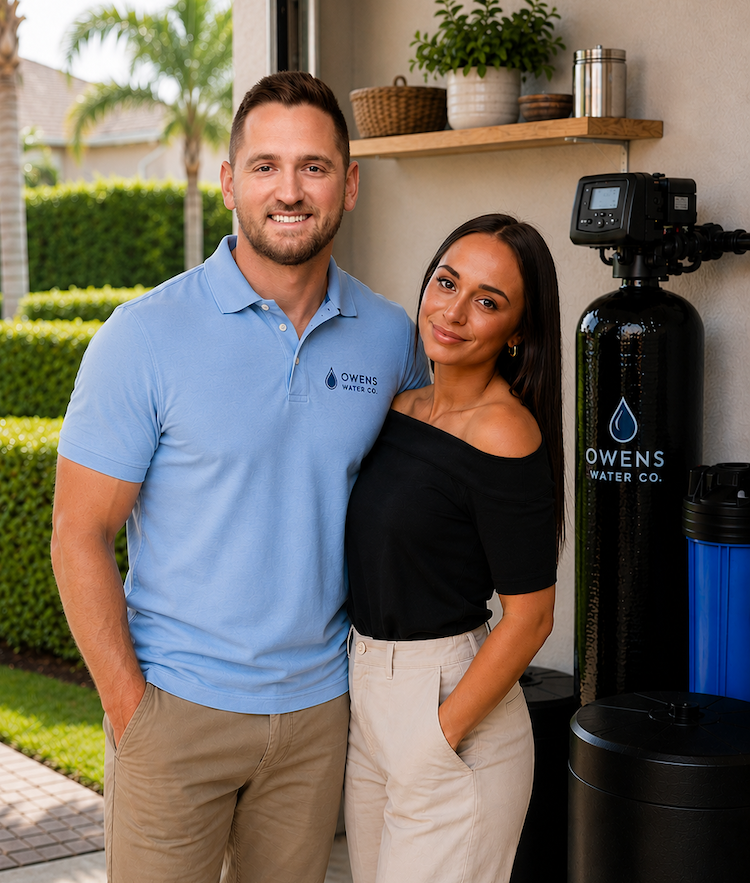
A note from our family
We sell both whole-home softening systems and reverse osmosis drinking water systems at Owens Water Co. — but we'll tell you straight whether you need one, the other, or both.
If your shower door is spotless and your appliances are fine but your tap water tastes weird, you might just need an RO. If your water tastes fine but your appliances are dying and your shower door looks permanently smudged, you need a softener and probably not an RO. Most SWFL homes need both, but not every home does.
Call or text us at (239) 256-4014 for a no-pressure conversation about your specific situation. We'll listen to what you're dealing with, ask about your home and your water source, and give you an honest recommendation — even if that recommendation is "you really only need one of these."
— Alex and Annie, Owens Water Co. Bonita Springs, FL